Showing posts with label adventure travel. Show all posts

Monday, August 26, 2013

Mother of God, Book - Coming Soon!


Paul RosolieToday Tamandua's founder Paul Rosolie shared the cover for his upcoming book Mother of God on Facebook and Twitter. The book tells the story of Rosolie's explorations and discoveries in the deepest corners of the Amazon with rare wildlife, uncontacted tribes, and the fight to save our planet's most important biome. With endorsements from environmentalists like Jane Goodall, Bill McKibben, Jeremy Hance and adventurers and authors like Bear Grylls and Mark Adams - the book has been described as a 'gripping', 'awe-inspiring', 'rousing tale'. It comes out in Feb 2014!

To pre-order Mother of God on Amazon.com, and to read reviews from adventure and conservation leaders, click here

Monday, August 19, 2013

YOGA in the Amazon Rainforest

In a few weeks, for the first time ever - Tamandua will be hosting an expedition wholly devoted to yoga. And where could possibly be better? In the womb of the greatest proliferation of life to exist on earth, far from the clutter and confusion of civilization - deep in the peaceful depths of the Amazon. There are still places open, for those who want to join, and take their yoga farther...


Saturday, February 23, 2013

Tamandua WIldlife Video Nears THIRTY THOUSAND VEIWS in just three days!


Watching a new video by Amazon explorer, Paul Rosolie, one feels transported into a hidden world of stalking jaguars, heavyweight tapirs, and daylight-wandering giant armadillos. This is the Amazon as one imagines it as a child: still full of wild things. In just four weeks at a single colpa (or clay lick where mammals and birds gather) on the lower Las Piedras River, Rosolie and his team captured 30 Amazonian species on video, including seven imperiled species. However, the very spot Rosolie and his team filmed is under threat: the lower Las Piedras River is being infiltrated by loggers, miners, and farmers following the construction of the Trans-Amazon highway. Read the Full Article Here.


Thursday, July 19, 2012

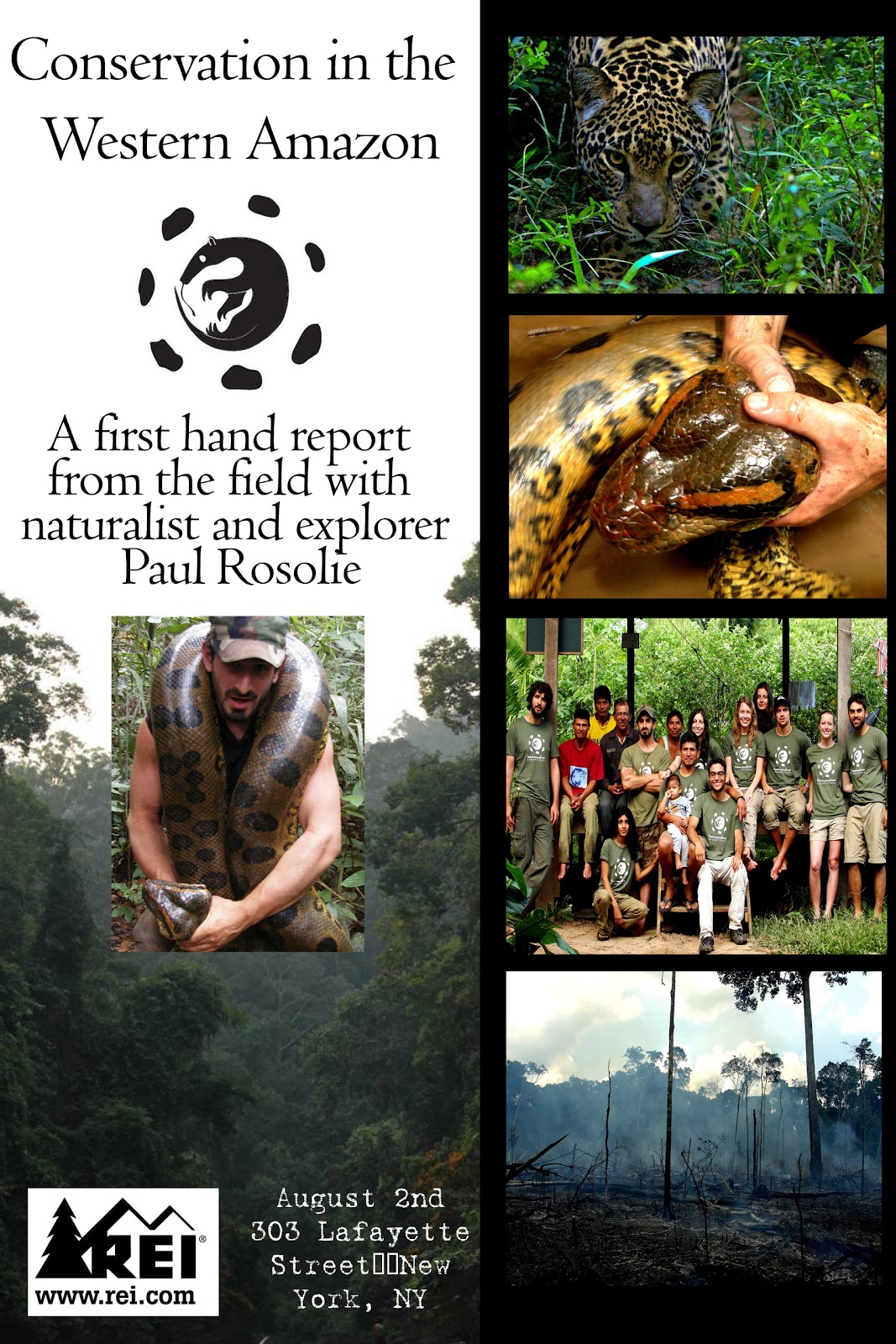
Tamandua Event in NYC


On tuesday August 2nd Tamandua will be at the REI in Soho. Few places on the planet are as mysterious and awe-inspiring as the Amazon jungle. Join naturalist and explorer, and Tamandua founder, Paul Rosolie for an interactive report from the field – rare wildlife, new-to-science ecosystems, uncontacted tribes, and how you can go where few ever have. Paul will discuss his past experiences leading groups, his solo treks deep into the jungle, and give ground level perspective of the conservation effort in the Amazon Rainforest. Learn what is needed to protect our planet’s most important biome.
You can register for the event here: http://www.rei.com/event/41258/session/52648. But sign up now because space is limited.
REI Outdoor Store: 303 Lafayette Street  New York, NY 10012, (212) 680-1938
www.tamanduajungle.com

Wednesday, May 2, 2012

Expedition Anaconda - Volunteers Needed!

       This June we are putting together an expedition aimed specifically at studying one of the most unique and mysterious ecosystems on Earth - the Floating Forest. In four years of study we still know very little about this strange habitat other than the fact that there seems to be no others like it, and that it is dominated by an abnormally high concentration of anacondas.
       Anacondas are endangered in the surrounding areas - killed by people out of fear and also because of habitat destruction. On the expedition this June we will be focusing exclusively on understanding how these giant snakes make use of the floating forest ecosystem. This will involve long hours of observation, tracking, as well as capturing and measuring any individual anacondas found. In particular there is a massive female well over 20ft in length which lives there. We will be attempting to locate her because she may be a record breaker and will help us not only to understand the ecosystem, but also to bring attention to our mission of protecting her home.
       Joining this expedition you will be up to your neck in Amazon-adventure, and amidst the coils of one of our planet's most fascinating species. But we need more volunteers so tell your friends and contact us to sign up! 

Tuesday, May 1, 2012

Volunteers protecting wildlife

     During our May and June expeditions in 2011 volunteers encountered issues with poaching. Men were entering the reserve to cut wood and hunt bushmeat - two activities that could severely harm the delicate ecosystem.
  Tamandua volunteers photographed and documented these activities and even came into direct contact with the poachers on more than one occasion. When enough information had been gathered local authorities were brought in to deal with the problem and send a message to would poachers. Since that time our preserve has been hunter and logger free - allowing the millions of species there to survive in safety! This awesome work would not be possible without our dedicated expedition members, people like you! 
    As we recruit for June and July expeditions we hope to continue working with travelers who want to be a part of helping to protect this incredible ecosystem.

Camera Traps Result in Images and New Knowledge

During last month's expedition, volunteers from India together with Tamandua Staff began testing our newly acquired camera traps in the jungle. They placed the cameras, which sense heat and motion, on the outskirts of a salt lick and waited. Salt licks are crucial deposits of sodium in the earth which numerous species of bird, mammal, and even insect depend on to maintain health. In the past we were able to study colpas through looking at the tracks left by animals in the clay - or by waiting for long periods of time to observe which species came.
With camera traps however we get a clear window into their world! What we found was dozens of species all sharing the space. Everything from agoutis to giant anteaters - and even howler monkeys, ocelots and jaguar!

In our upcoming expeditions camera traps will be a major asset to the research we do! More on the wildlife and photos coming soon!

Thursday, March 25, 2010

What is a Tamandua?


People all the time ask me what the name “tamandua” means; few know that it is actually one of the most interesting animals in the world. They belong to the order Xenarthra which is made up of a unique group of animals which occur only in the Americas. They are the anteaters, sloths, and armadillos. The group is known for their unique lifestyles and bizarre physical structure, and all bear large claws on their fore-limbs. Other unique adaptations include the armadillo’s turtle-like shell, the sloth’s slowness, and the anteater’s long tongued toothless mouth.

The three species of anteater found in the Amazon are the giant anteater, tamandua, and silky anteater. Tamanduas are small and arboreal. They have a prehensile tail and sharp-clawed front limbs that aid in climbing and opening ant nests. Evolution has given them a tongue that can reach over ten inches in length and a toothless mouth. Perfect adaptations for an animal that loves slurping ants and termites right out of their holes. Affectionate and smart, tamanduas are sometimes kept as pets. And although I have never cared for a tamandua I have had the opportunity to nurse an orphaned tamandua grande (giant anteater) to health. They are one of my favorite animals, and the inspiration for the Tamandua Rainforest Expeditions name. They are one of our favorite animals to spot while out in the field!

Thursday, March 18, 2010

The Floating Dwarf Forest, Satellite View

While searching over satellite images of the area of our new project I noticed something I had never even thought to look for: a long swamp which ended in a patchy lake - the floating forest! These Google Earth images are of the dense jungle we will be exploring in both May and June and the unique floating forest ecosystem within it. We now know that the swamp-area is far larger than we had previously estimated. Both the great swamp and the dense jungle around it is all area which we have yet to explore.


Left: A view of the vast jungle we will be exploring and mapping, the floating forest is visible in the corner - click for a larger image.


Above: A close-up view of the patchy floating forest that rests on top of the massive lake.

For the people not looking foreward to anaconda infested swamp exploration I am happy to report that in the past week Infierno construction workers have spotted squirrel monkeys, howler monkeys, blue and yellow macaws, toucan, sloth, peccary, and a tapir (tracks). Both our transects and our colpa shifts should be rewarding - it looks like a surprising amount of wildlife is existing in this particular stretch of jungle. And although it seems like a healthy ecosystem, it is threatened by hunting, logging, and human encroachment. For this reason during research shifts you will be looking for evidence of indicator species. Bird species such as spix's guan, pale winged trumpeter, and razer pilled curasaow are indicators of primary forest because they are the first species hunted by humans, so their presence will always be valuable to record. Also on our list of indicators are mammals. Jaguar being the most important, we will also be searching for evidence of tapir, peccary, and other species.

Thursday, March 11, 2010

Tamandua Expedition Featured on Mongabay.com

Mongabay.com is THE rainforest conservation news site. They are responsible for educating millions on the current issues facing tropical consevation, climate change, and deforestation today. This month, Mongabay.com interviewed Tamandua Expedition Leader Paul Rosolie about the mission of our conservation expeditions:

To read the interview visit:
http://news.mongabay.com/2010/0310-hance_rosolie.html