Showing posts with label adventure volunteering. Show all posts

Thursday, September 26, 2013

New Year's in the Jungle - Upcoming Expedition

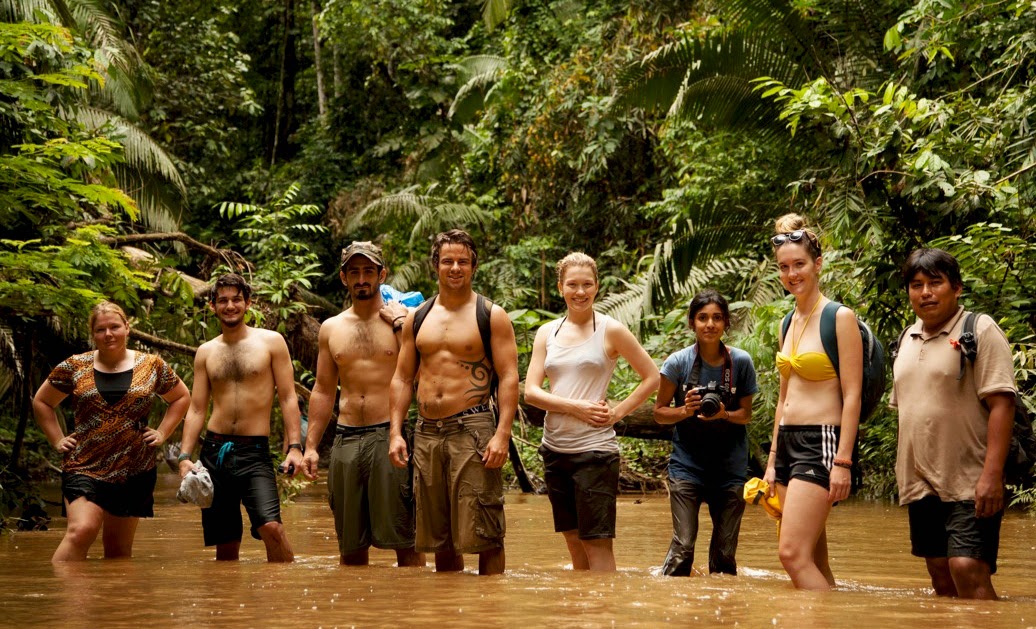
This week Tamandua Expeditions has begun taking on volunteers for our most popular annual expedition. December 29th be a part of the team that travels up the Rio Piedras, to study biodiversity and protect forest. We'll be working with camera traps, transect research, and a variety of other projects. To find out more, or to sign up, contact us at adventure@tamanduajungle.com

Tuesday, May 1, 2012

Camera Traps Result in Images and New Knowledge

During last month's expedition, volunteers from India together with Tamandua Staff began testing our newly acquired camera traps in the jungle. They placed the cameras, which sense heat and motion, on the outskirts of a salt lick and waited. Salt licks are crucial deposits of sodium in the earth which numerous species of bird, mammal, and even insect depend on to maintain health. In the past we were able to study colpas through looking at the tracks left by animals in the clay - or by waiting for long periods of time to observe which species came.
With camera traps however we get a clear window into their world! What we found was dozens of species all sharing the space. Everything from agoutis to giant anteaters - and even howler monkeys, ocelots and jaguar!

In our upcoming expeditions camera traps will be a major asset to the research we do! More on the wildlife and photos coming soon!

Thursday, March 25, 2010

What is a Tamandua?


People all the time ask me what the name “tamandua” means; few know that it is actually one of the most interesting animals in the world. They belong to the order Xenarthra which is made up of a unique group of animals which occur only in the Americas. They are the anteaters, sloths, and armadillos. The group is known for their unique lifestyles and bizarre physical structure, and all bear large claws on their fore-limbs. Other unique adaptations include the armadillo’s turtle-like shell, the sloth’s slowness, and the anteater’s long tongued toothless mouth.

The three species of anteater found in the Amazon are the giant anteater, tamandua, and silky anteater. Tamanduas are small and arboreal. They have a prehensile tail and sharp-clawed front limbs that aid in climbing and opening ant nests. Evolution has given them a tongue that can reach over ten inches in length and a toothless mouth. Perfect adaptations for an animal that loves slurping ants and termites right out of their holes. Affectionate and smart, tamanduas are sometimes kept as pets. And although I have never cared for a tamandua I have had the opportunity to nurse an orphaned tamandua grande (giant anteater) to health. They are one of my favorite animals, and the inspiration for the Tamandua Rainforest Expeditions name. They are one of our favorite animals to spot while out in the field!

Thursday, March 18, 2010

The Floating Dwarf Forest, Satellite View

While searching over satellite images of the area of our new project I noticed something I had never even thought to look for: a long swamp which ended in a patchy lake - the floating forest! These Google Earth images are of the dense jungle we will be exploring in both May and June and the unique floating forest ecosystem within it. We now know that the swamp-area is far larger than we had previously estimated. Both the great swamp and the dense jungle around it is all area which we have yet to explore.


Left: A view of the vast jungle we will be exploring and mapping, the floating forest is visible in the corner - click for a larger image.


Above: A close-up view of the patchy floating forest that rests on top of the massive lake.

For the people not looking foreward to anaconda infested swamp exploration I am happy to report that in the past week Infierno construction workers have spotted squirrel monkeys, howler monkeys, blue and yellow macaws, toucan, sloth, peccary, and a tapir (tracks). Both our transects and our colpa shifts should be rewarding - it looks like a surprising amount of wildlife is existing in this particular stretch of jungle. And although it seems like a healthy ecosystem, it is threatened by hunting, logging, and human encroachment. For this reason during research shifts you will be looking for evidence of indicator species. Bird species such as spix's guan, pale winged trumpeter, and razer pilled curasaow are indicators of primary forest because they are the first species hunted by humans, so their presence will always be valuable to record. Also on our list of indicators are mammals. Jaguar being the most important, we will also be searching for evidence of tapir, peccary, and other species.

Friday, March 12, 2010

Both May and June 2010 Expeditions Full to Capacity!!

As of today both of Tamandua's spring trips are full. Both May and June are full to capacity with volunteers from a diversity of backgrounds. A New York firefighter, Native American Naturalist,a Belgian, a South African, and many more.

All will be participating in our volunteer projects which include education, exploration of unknown jungle, mapping, observing, and in one case - relocation of a stranded species.

It is going to be a wild ride!