Showing posts with label amazon jungle. Show all posts

Monday, August 26, 2013

Mother of God, Book - Coming Soon!


Paul RosolieToday Tamandua's founder Paul Rosolie shared the cover for his upcoming book Mother of God on Facebook and Twitter. The book tells the story of Rosolie's explorations and discoveries in the deepest corners of the Amazon with rare wildlife, uncontacted tribes, and the fight to save our planet's most important biome. With endorsements from environmentalists like Jane Goodall, Bill McKibben, Jeremy Hance and adventurers and authors like Bear Grylls and Mark Adams - the book has been described as a 'gripping', 'awe-inspiring', 'rousing tale'. It comes out in Feb 2014!

To pre-order Mother of God on Amazon.com, and to read reviews from adventure and conservation leaders, click here

Monday, September 3, 2012

Moments from the Field

When you walk through the forest in Amazonia one of the things that is strikes many people is the realization that anything can happen. Though rainforests are packed with wildlife, many species have spent millions of years evolving to be camouflaged, silent, and virtual invisible to the senses - which of course helps them to remain undetected by predators. Yet in the jungle, you never know when one of these hidden creatures will reveal itself.

Not long ago several volunteers and an expedition leader were on one of our trails and stopped to listen for a while. They were standing quietly when they heard rustling. The noise grew louder until a giant anteater crossed the trail only twenty feet in front of them. They watched in amazement as the giant trotted off into the jungle.

Giant anteaters are often killed by locals who feel that they are dangerous. Folklore casts them as an aggressive giant that can stand on its hind legs to slash and kill a man, or dogs (which is not untrue, they will defend themselves if provoked). But these are gentle animals.

We have found the population of giant anteaters within our reserve to be healthy and this year we are going to be taking an in depth look at their numbers, habits, and secrets.  The below photo is not from Tamandua Expeditions, it was found on the internet, but shows the size and beauty of one of the most unusual creatures we work with! Can you believe how big that is?


Thursday, July 19, 2012

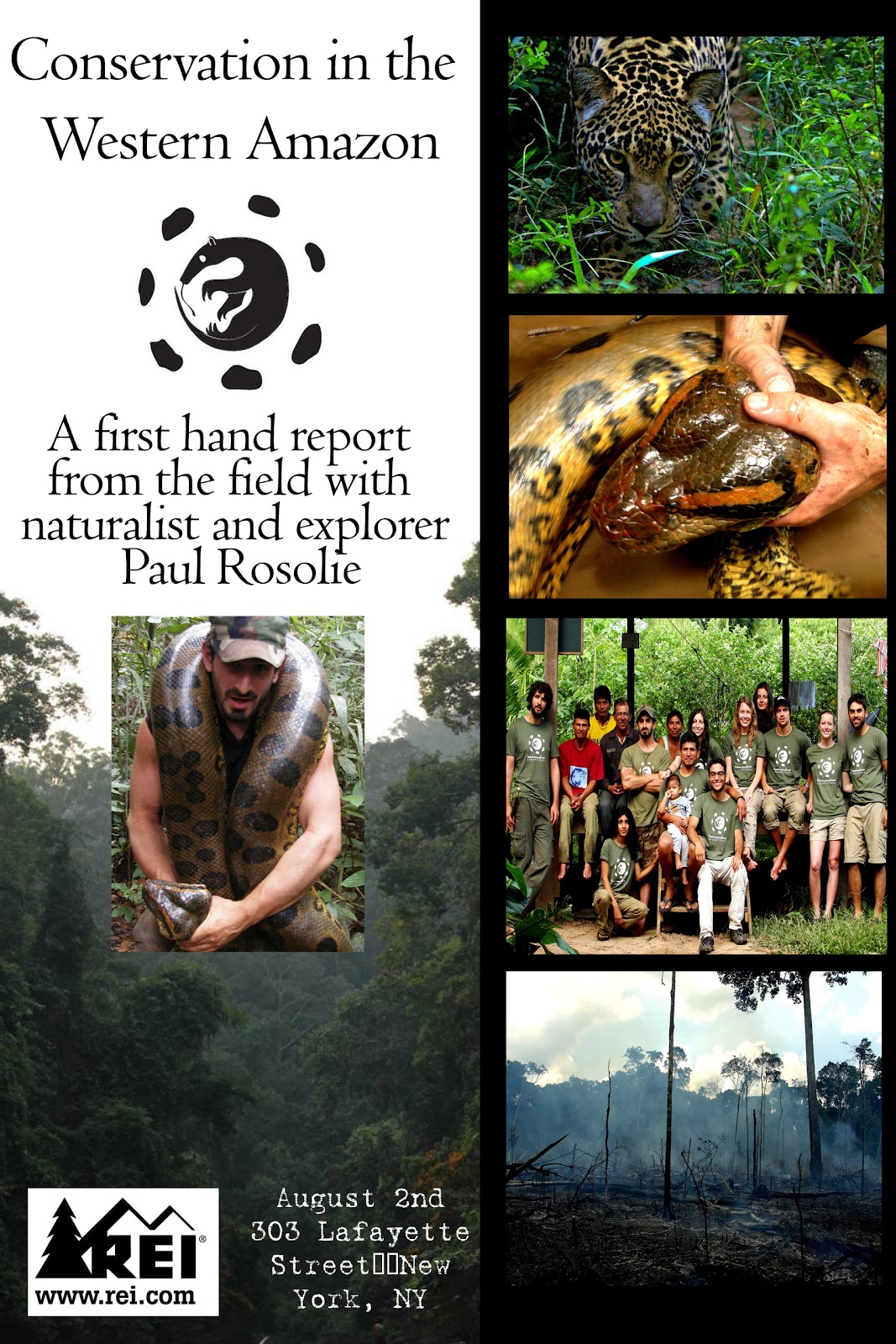
Tamandua Event in NYC


On tuesday August 2nd Tamandua will be at the REI in Soho. Few places on the planet are as mysterious and awe-inspiring as the Amazon jungle. Join naturalist and explorer, and Tamandua founder, Paul Rosolie for an interactive report from the field – rare wildlife, new-to-science ecosystems, uncontacted tribes, and how you can go where few ever have. Paul will discuss his past experiences leading groups, his solo treks deep into the jungle, and give ground level perspective of the conservation effort in the Amazon Rainforest. Learn what is needed to protect our planet’s most important biome.
You can register for the event here: http://www.rei.com/event/41258/session/52648. But sign up now because space is limited.
REI Outdoor Store: 303 Lafayette Street  New York, NY 10012, (212) 680-1938
www.tamanduajungle.com

Saturday, February 11, 2012

A New Year and a New Mission!

Over the years Tamandua has had tons of awesome expeditions and encounters with wildlife, with volunteers from all over the world joining our team. Today there are thousands of acres of rainforest protected because of these expeditions, a major victory. But we still have work to do. The land we protect is only protected when we have volunteers there working and studying, and this year, 2012, marks the start of the next step. We are going to start trying to have a constant presence - that means having groups year round. This means continuing to protect the three locations we currently have, as well as the giant old growth trees, the jaguars, giant anteaters, tapirs, and massive anacondas and millions of other organisms that call them home from poaching and habitat destruction. It also will allow us to continue to work with our indigenous staff to ensure that these unique areas stay protected forever. We are taking things to the next step, and its a very exciting time!

In the next few weeks we are going to be announcing our summer expeditions dates, starting in late June we are going to be going deeper into the floating forest than ever before, and in July we are making an epic return to the Las Piedras Research Station!

More updates coming soon!

Thursday, March 25, 2010

What is a Tamandua?


People all the time ask me what the name “tamandua” means; few know that it is actually one of the most interesting animals in the world. They belong to the order Xenarthra which is made up of a unique group of animals which occur only in the Americas. They are the anteaters, sloths, and armadillos. The group is known for their unique lifestyles and bizarre physical structure, and all bear large claws on their fore-limbs. Other unique adaptations include the armadillo’s turtle-like shell, the sloth’s slowness, and the anteater’s long tongued toothless mouth.

The three species of anteater found in the Amazon are the giant anteater, tamandua, and silky anteater. Tamanduas are small and arboreal. They have a prehensile tail and sharp-clawed front limbs that aid in climbing and opening ant nests. Evolution has given them a tongue that can reach over ten inches in length and a toothless mouth. Perfect adaptations for an animal that loves slurping ants and termites right out of their holes. Affectionate and smart, tamanduas are sometimes kept as pets. And although I have never cared for a tamandua I have had the opportunity to nurse an orphaned tamandua grande (giant anteater) to health. They are one of my favorite animals, and the inspiration for the Tamandua Rainforest Expeditions name. They are one of our favorite animals to spot while out in the field!

Thursday, March 18, 2010

The Floating Dwarf Forest, Satellite View

While searching over satellite images of the area of our new project I noticed something I had never even thought to look for: a long swamp which ended in a patchy lake - the floating forest! These Google Earth images are of the dense jungle we will be exploring in both May and June and the unique floating forest ecosystem within it. We now know that the swamp-area is far larger than we had previously estimated. Both the great swamp and the dense jungle around it is all area which we have yet to explore.


Left: A view of the vast jungle we will be exploring and mapping, the floating forest is visible in the corner - click for a larger image.


Above: A close-up view of the patchy floating forest that rests on top of the massive lake.

For the people not looking foreward to anaconda infested swamp exploration I am happy to report that in the past week Infierno construction workers have spotted squirrel monkeys, howler monkeys, blue and yellow macaws, toucan, sloth, peccary, and a tapir (tracks). Both our transects and our colpa shifts should be rewarding - it looks like a surprising amount of wildlife is existing in this particular stretch of jungle. And although it seems like a healthy ecosystem, it is threatened by hunting, logging, and human encroachment. For this reason during research shifts you will be looking for evidence of indicator species. Bird species such as spix's guan, pale winged trumpeter, and razer pilled curasaow are indicators of primary forest because they are the first species hunted by humans, so their presence will always be valuable to record. Also on our list of indicators are mammals. Jaguar being the most important, we will also be searching for evidence of tapir, peccary, and other species.

Thursday, March 11, 2010

Tamandua Expedition Featured on Mongabay.com

Mongabay.com is THE rainforest conservation news site. They are responsible for educating millions on the current issues facing tropical consevation, climate change, and deforestation today. This month, Mongabay.com interviewed Tamandua Expedition Leader Paul Rosolie about the mission of our conservation expeditions:

To read the interview visit:
http://news.mongabay.com/2010/0310-hance_rosolie.html

Monday, March 8, 2010

A Volunteer's Account of an Expeditoins First Night:
by Norm Rasmussen

"It was a two day, up-river trip from Puerto Maldonado to a small station in the middle of the jungle. In fact, if you look on Google Maps there is no civilization around the station for miles and miles. Night one on the river happened to fall on New Years Eve (I believe, it might have been the day before). As night began to fall, we saw a steep bank with a small roof on top, peering over the grasses. We tied the boat to the shore and began to unload the boat. Our accommodations for the night were a 2-person tent under a small roof. Jungle all around us, and a steady moving river behind us, life was just as vibrant at night as it was during the day.
Going back down the boat, night had fully fallen and we all needed our head lamps to navigate. One of our expedition leaders, Paul, was standing on the bow of the boat and called me over. Leaning forward, he was looking along the bank of the river at something. A small mist began to fall from the sky. “What is it?” I said to him. “There, you see those two red dots off in the distance?” he responded. I switched the setting on my headlamp to give myself a little more light and peered off into the distance. And there I saw it. About 20-30 feet in front of the boat, under some branches and leaves, two little red dots floated among the murky water. “Yeah, I see that, what is it?” He turned to me and smiled, “Croc eyes. No more than a couple feet long. C'mon lets go.”
'Let's go?' I thought to myself. But before I could finish the thought, Paul was in his boxers sitting on the side of the boat explaining that I have to get into the water slowly so as not to scare the crocodile. The mist turned into a heavy drizzle as I stood there dumbfounded. I was half startled at how quickly he got into the water. The other half was startled because of how quickly he expected me to get into the water. Just his head above the water, he looked up at me. “The water is fine! Imagine your first chance to catch a croc!” Now excited by the prospect of what I was getting myself into on the first day in the Amazon jungle, my pants and shirt were off before I knew what was happening. But I guess my body made the decision and acted before my head caught up.


The brown murky water surrounded my body. It didn't smell bad, and it was surprisingly warm. But with a cold rain beginning to turn heavy, the water seemed much warmer. My boxers waved around my thighs as I used my feet to navigate the root-covered clay floor. Moving my hands and feet slowly, I carefully navigated from one bunch of roots and plants to another. We stopped often and peered along the surface of the water, making eye contact with the two glowing embers that awaited me at the end of the long light-tunnel.
At one point we lost track of it, it sensed we were there. When we thought we lost it, Paul and I were floating in the water. Each using a hand on a branch to keep somewhat buoyant, we simply floated. The rain grew heavy and now a flash of lightning lit the area around me. As the thunder cracked, I saw Paul's head lamp turn towards me. He looked at me and said, “This is pretty damn cool, huh? You are chasing crocs, in an amazon river, in the middle of a thunder storm. At night.” I smiled at his statement and looked around, appreciating how alive I felt where I was. The red eyes appeared and I was mesmerized. Lightning flashed and the rain fell. We floated off towards the glowing red embers."


Above: Norm with expedition leaders Paul and JJ, and a midsize dwarf caiman.

Thursday, February 18, 2010

Announcing the June 2010 Expedition

Due to the overwhelming interest in the May 2010 expedition, Tamandua is announcing a second Spring 2010 Trip: June 2-15th. With volunteers arriving in May to begin research and exploration of the Infierno Forest, our team members in June will be able to pick up where they leave off. This will help significantly in assessing the ecosystem - more days in the field doing research means we learn lots more.

If you are interested in joining our June expedition, look to the bottom of this page - there you'll find a description of our itinerary for May, an outline we will maintain in June.

Tuesday, February 16, 2010

The Giant Anacondas of the Floating Dwarf Forest

For anyone interested in coming on the spring expedition, an understanding of the adventures ahead is a must. However while reading this please note that our expedition will have numerous projects and people who do not want to deal with snakes DO NOT have to. Most of our efforts will be observing mammals, recording bird and butterfly species, and having fun. But for those who want to join me for one or two intense nights, we have the opportunity to explore something very special. Here’s the deal:


For three years JJ and I had been hearing stories about “The Lake”, and although its reputation was unquestionable, we had never had time to explore it. Located on the outskirts of the Indigenous Community of Infierno, the lake was a semi-mythical location to all those who knew of it. It was said to be filled with only the most monstrous and deadly creatures the jungle had to offer. For my part, I assumed it was mostly exaggeration that filled its waters.

But in June of 2009, after a boat journey, a taxi ride, and a three hour hike through the jungle, we reached the water’s edge. It took less than five seconds of looking out over the lake to realize that we were looking at a place humans do not go. It looked like something out of Jurassic Park; the jungle surrounding us was sinister and wild. At first we barely understood what we were seeing. It looked like a massive clearing in the jungle, where for some reason the tops of trees grew directly out of the ground. Closer study however reveled that it was indeed a lake; the ground however was anything but. As we made our way out onto the lake (yes onto), we began to discover what it was we were seeing.


Floating on the surface of this multi-square kilometer water body was a dense coagulation of moss and grass. It was as though someone had laid a blanket over the surface of the lake. It was not uniform, and was broken in many places, but covered the majority of the lake’s surface in its botanical embrace. Growing from the green mat was a dwarf forest which consisted of a single species of tree that neither JJ nor I had ever seen before. The only form disrupting the homogeneity of the dwarf forest across the lake was the tops of palm trees. These were Aguaje palms. The palms provided us with a reference with which to measure our surroundings, we knew that they only matured (bore fruit) at heights of over thirty feet, and could grow to sixty. This meant that the tree tops we were walking past were rooted to the lakebed perhaps 30 to 60 feet below.


As we walked the mossy bed rippled and sagged, constantly threatening to break and send us down into the black water below. To be honest, both JJ and I held onto each other in fear. We spent hours making our way over the alien terrain. Along the way we saw some truly massive crocs in the water. Their glowing red eyes scrutinizing us as we made our way through their world. We also spotted pathways through the grass, where large creatures had slid through. JJ was convinced that they were anaconda pugs, drag marks. I however thought that they were far too large to be from a snake, even an anaconda. The moon that night was so brilliant that we did not need our headlamps, and navigated the surreal night scene without any aid.

Over four hours later we had still not reached the other side of the lake. Along the way we had seen owls, frogs, crocs, a stingray, and several dozen more “anaconda tracks”. Our hesitation had subsided and now we were cruising, this was exploring at its best, a completely new ecosystem nestled in the already astounding diversity of the Amazon. It was just past 2am when it happened.

JJ grabbed my sleeve and we both froze. Stretching in front of us was the immense trunk of the largest anaconda either of us has ever seen. Our mouths were open; the girth of the snake was that of an oil drum, easily dwarfing the fifteen-footers we had caught a few weeks earlier. This snake was upwards of 25ft, a giant. Oh, and I forgot to mention, there was more than one. Coiled around the behemoth female was a 12-15 foot male. JJ and I stood for over five minutes staring in awe, our minds were just blown. The snakes were only five feet away; we had practically walked on top of them.

The behemoth female detected our presence and was not pleased. Her dorsal blotches began winding as her coils mobilized towards the water. Realizing that a photograph of a snake this big would mean international interest, I jumped on her back in a feeble attempt to try and restrain her. But my weight did nothing to slow her progress, in fact, she carried me along without hesitation. With arms wrapped around her body, my finger tips could not touch, but I pulled all the same, digging my heels into the floating bed and trying to stop her. She pulled me right through the grass of the floating forest; my legs, chest, and then shoulders plunging into the black water.

Relinquishing my hold I scrambled out of the water and back onto the raft of peat and grass. The last thing I saw was her tail slip by my face and down into the black lake. JJ and I wrestled the smaller male, who was measured at just over 13.5 feet. After hiking out off of the alien forest we returned to camp that night stunned. A snake as large as that female is a living legend, something scientists speculate exists, but which nobody actually sees. We promised each other that we would return and further explore the floating forest. It appeared from the tracks that it is jammed full of anacondas in the dry season, a seasonal sanctuary. Also in the are of the lake that night we spotted a giant armadillo, four different sets of jaguar tracks, and found the wings of a blue morpho. In May we will be further studying the lake and surrounding swamp, finding out what other species they are home to. There are many questions to be answered, but one thing is certain: there is nowhere else like this in the jungle.

Friday, February 5, 2010

The First Day of Scouting

Recent Scouting for Our May Expedition:

Coming to Infierno is a big change for Tamandua, for the past five years we have worked primarily from a single location on the river Las Pidras. Coming to a new location on the Tambopata River means a new setting, new wildlife, and a new mission. It also means that we have much to learn about the territory surrounding our new research station.


On January 16th of this year expedition leaders Paul Rosolie and Juan Julio Duran began a week-long survey of this new swath of jungle. Knowing that the area had been subject to poaching and wood-harvesting we were concerned about the health of the ecosystem as well as hopeful that it would contain a variety of wildlife that would satisfy the hopes of our prospective volunteers. Little did we know that we were going to be more than reassured.


On our first day of exploring we left the tranquility of the research station and set out on a five hour trek through the old, narrow hunting trails and animal pathways that snake through the jungle at Infierno. Beginning in secondary forest we traveled deeper into the forest which quickly transformed into pristine, primary forest. With massive old growth trees rising all around us, we weaved through a land of giants. The first significant find of the day came in the form of a tremendous kapok tree that towered about the rest of the canopy. With a lifespan easily upwards of 800 years old, this towering pillar of the Amazon must have begun growing long before the arrival of of Europeans on the South American continent.


Continuing on we began to uncover a multitude of mammal colpas hidden in the forest. Colpas are places where salt deposits in the ground's clay attract a variety of herbivores seeking to consume vital minerals that aid their survival. Monkeys, tapir, peccary, agouti, macaws, sloth, and many other species are attracted to these areas where they eat the clay and socialize. We found evidence of two species of peccary, newly laid howler monkey tracks, and more than one tapir visit. We observed a troop of Amazon coati descending from mid canopy to feed, a very rare sight. Amidst the calls of toucans, macaws, and spix's guan (a species which is an indicator of healthy ecosystems), we began to track a heard of collared peccary. Following the heard, we silently weaved through a wonderland of tropical life. Our hunt brought us to the edge of a small cliff, at the base of which was a small stream; we had reached another colpa. This appeared to be an active colpa; it bore recent footprints from dozens of animal visitors. Further investigation of the site revealed a tremendous find: a blue morpho butterfly. Perched on the red clay of the colpa's floor it was gently fluttering its massive wings as it's proboscis lapped salt.

It had been a long hike and we were ready to turn back, the forest seemed to be in excellent condition and we had had a good first day of investigating. As we began to leave however the blue morpho we had been watching took flight, flashing its wicked blue wings through the shadowy green. As we watched in awe, our vision landed on a sight which took everyone's breath away. Coiled in the gentle flowing stream that ran at the colpa's base, was a tremendous anaconda, in its grip lay the body of a recently constricted pig.

Below: The anaconda with her prey:


The peccary herd we had been following had crossed the colpa and narrow stream, this anaconda had been lying in wait in exactly the right spot.
The anaconda measured just under fifteen feet long, a giant female.

We returned to base filled with enthusiasm, our first exploration of our new location had been an overwhelming success. The following days did not disappoint either. Also sighted were puma tracks, a blue faced motmot, blue and yellow macaws, one giant armadillo burrow, giant anteater tracks, and a very healthy population of the legendary blue morpho.