Showing posts with label volunteering. Show all posts

Monday, September 3, 2012

Moments from the Field

When you walk through the forest in Amazonia one of the things that is strikes many people is the realization that anything can happen. Though rainforests are packed with wildlife, many species have spent millions of years evolving to be camouflaged, silent, and virtual invisible to the senses - which of course helps them to remain undetected by predators. Yet in the jungle, you never know when one of these hidden creatures will reveal itself.

Not long ago several volunteers and an expedition leader were on one of our trails and stopped to listen for a while. They were standing quietly when they heard rustling. The noise grew louder until a giant anteater crossed the trail only twenty feet in front of them. They watched in amazement as the giant trotted off into the jungle.

Giant anteaters are often killed by locals who feel that they are dangerous. Folklore casts them as an aggressive giant that can stand on its hind legs to slash and kill a man, or dogs (which is not untrue, they will defend themselves if provoked). But these are gentle animals.

We have found the population of giant anteaters within our reserve to be healthy and this year we are going to be taking an in depth look at their numbers, habits, and secrets.  The below photo is not from Tamandua Expeditions, it was found on the internet, but shows the size and beauty of one of the most unusual creatures we work with! Can you believe how big that is?


Friday, August 31, 2012

Upcoming Expedition!

This week we are formally announcing the Dec. 29th to Jan. 12th Expedition. With a team volunteers from all over the world already coming together, it is going to be an incredible trip. Our projects will focus on monitoring large mammal populations, studying the explosive rainy-season amphibian activity, and exploring some entirely untouched areas of jungle.

As with every expedition Tamandua launches, this is your chance to explore the most incredible ecosystem on Earth, meet new people, and make a difference!

Find out more at www.tamanduajungle.com, or email us at adventure@tamanduajungle.com for info on how you can become a Junglekeeper!

Places are limited - apply now!

Thursday, July 19, 2012

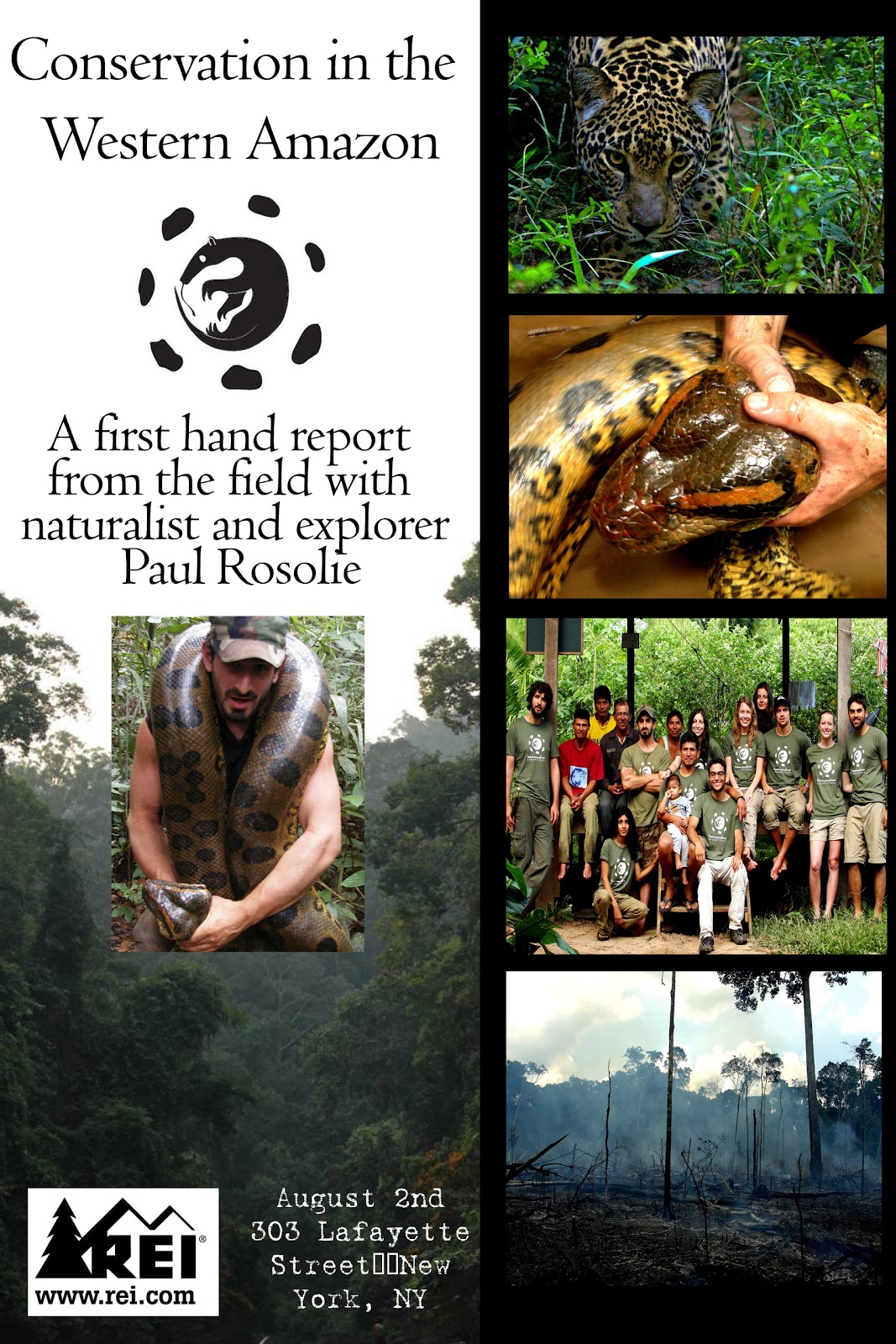
Tamandua Event in NYC


On tuesday August 2nd Tamandua will be at the REI in Soho. Few places on the planet are as mysterious and awe-inspiring as the Amazon jungle. Join naturalist and explorer, and Tamandua founder, Paul Rosolie for an interactive report from the field – rare wildlife, new-to-science ecosystems, uncontacted tribes, and how you can go where few ever have. Paul will discuss his past experiences leading groups, his solo treks deep into the jungle, and give ground level perspective of the conservation effort in the Amazon Rainforest. Learn what is needed to protect our planet’s most important biome.
You can register for the event here: http://www.rei.com/event/41258/session/52648. But sign up now because space is limited.
REI Outdoor Store: 303 Lafayette Street  New York, NY 10012, (212) 680-1938
www.tamanduajungle.com

Tuesday, May 1, 2012

Volunteers protecting wildlife

     During our May and June expeditions in 2011 volunteers encountered issues with poaching. Men were entering the reserve to cut wood and hunt bushmeat - two activities that could severely harm the delicate ecosystem.
  Tamandua volunteers photographed and documented these activities and even came into direct contact with the poachers on more than one occasion. When enough information had been gathered local authorities were brought in to deal with the problem and send a message to would poachers. Since that time our preserve has been hunter and logger free - allowing the millions of species there to survive in safety! This awesome work would not be possible without our dedicated expedition members, people like you! 
    As we recruit for June and July expeditions we hope to continue working with travelers who want to be a part of helping to protect this incredible ecosystem.

Camera Traps Result in Images and New Knowledge

During last month's expedition, volunteers from India together with Tamandua Staff began testing our newly acquired camera traps in the jungle. They placed the cameras, which sense heat and motion, on the outskirts of a salt lick and waited. Salt licks are crucial deposits of sodium in the earth which numerous species of bird, mammal, and even insect depend on to maintain health. In the past we were able to study colpas through looking at the tracks left by animals in the clay - or by waiting for long periods of time to observe which species came.
With camera traps however we get a clear window into their world! What we found was dozens of species all sharing the space. Everything from agoutis to giant anteaters - and even howler monkeys, ocelots and jaguar!

In our upcoming expeditions camera traps will be a major asset to the research we do! More on the wildlife and photos coming soon!

Friday, March 12, 2010

Both May and June 2010 Expeditions Full to Capacity!!

As of today both of Tamandua's spring trips are full. Both May and June are full to capacity with volunteers from a diversity of backgrounds. A New York firefighter, Native American Naturalist,a Belgian, a South African, and many more.

All will be participating in our volunteer projects which include education, exploration of unknown jungle, mapping, observing, and in one case - relocation of a stranded species.

It is going to be a wild ride!

Monday, March 8, 2010

A Volunteer's Account of an Expeditoins First Night:
by Norm Rasmussen

"It was a two day, up-river trip from Puerto Maldonado to a small station in the middle of the jungle. In fact, if you look on Google Maps there is no civilization around the station for miles and miles. Night one on the river happened to fall on New Years Eve (I believe, it might have been the day before). As night began to fall, we saw a steep bank with a small roof on top, peering over the grasses. We tied the boat to the shore and began to unload the boat. Our accommodations for the night were a 2-person tent under a small roof. Jungle all around us, and a steady moving river behind us, life was just as vibrant at night as it was during the day.
Going back down the boat, night had fully fallen and we all needed our head lamps to navigate. One of our expedition leaders, Paul, was standing on the bow of the boat and called me over. Leaning forward, he was looking along the bank of the river at something. A small mist began to fall from the sky. “What is it?” I said to him. “There, you see those two red dots off in the distance?” he responded. I switched the setting on my headlamp to give myself a little more light and peered off into the distance. And there I saw it. About 20-30 feet in front of the boat, under some branches and leaves, two little red dots floated among the murky water. “Yeah, I see that, what is it?” He turned to me and smiled, “Croc eyes. No more than a couple feet long. C'mon lets go.”
'Let's go?' I thought to myself. But before I could finish the thought, Paul was in his boxers sitting on the side of the boat explaining that I have to get into the water slowly so as not to scare the crocodile. The mist turned into a heavy drizzle as I stood there dumbfounded. I was half startled at how quickly he got into the water. The other half was startled because of how quickly he expected me to get into the water. Just his head above the water, he looked up at me. “The water is fine! Imagine your first chance to catch a croc!” Now excited by the prospect of what I was getting myself into on the first day in the Amazon jungle, my pants and shirt were off before I knew what was happening. But I guess my body made the decision and acted before my head caught up.


The brown murky water surrounded my body. It didn't smell bad, and it was surprisingly warm. But with a cold rain beginning to turn heavy, the water seemed much warmer. My boxers waved around my thighs as I used my feet to navigate the root-covered clay floor. Moving my hands and feet slowly, I carefully navigated from one bunch of roots and plants to another. We stopped often and peered along the surface of the water, making eye contact with the two glowing embers that awaited me at the end of the long light-tunnel.
At one point we lost track of it, it sensed we were there. When we thought we lost it, Paul and I were floating in the water. Each using a hand on a branch to keep somewhat buoyant, we simply floated. The rain grew heavy and now a flash of lightning lit the area around me. As the thunder cracked, I saw Paul's head lamp turn towards me. He looked at me and said, “This is pretty damn cool, huh? You are chasing crocs, in an amazon river, in the middle of a thunder storm. At night.” I smiled at his statement and looked around, appreciating how alive I felt where I was. The red eyes appeared and I was mesmerized. Lightning flashed and the rain fell. We floated off towards the glowing red embers."


Above: Norm with expedition leaders Paul and JJ, and a midsize dwarf caiman.

Thursday, February 18, 2010

Announcing the June 2010 Expedition

Due to the overwhelming interest in the May 2010 expedition, Tamandua is announcing a second Spring 2010 Trip: June 2-15th. With volunteers arriving in May to begin research and exploration of the Infierno Forest, our team members in June will be able to pick up where they leave off. This will help significantly in assessing the ecosystem - more days in the field doing research means we learn lots more.

If you are interested in joining our June expedition, look to the bottom of this page - there you'll find a description of our itinerary for May, an outline we will maintain in June.